
The Owosso & Corunna Electric Railway was an electric street-railway service linking Owosso and Corunna, Michigan, whose predecessors began operating as a steam-powered street railway in the early 1890s. A county history written around 1906 dates the original line to 1893 and states that electric power replaced steam after approximately two years. Later company reorganizations connected the short local railway to the larger Michigan United rail network.[1][2]
The railway served as both everyday local transportation and a piece of shared street infrastructure. Its history includes a rebuilding dispute with Corunna in 1913 and a 1918 Michigan Supreme Court decision in which Owosso successfully asserted its authority over track placement on Corunna Avenue.[3][4]
Research continuing: The exact track alignment, early company dates, and final day of local streetcar service are not fully established. The route illustration below is a schematic interpretation of reported streets, not a surveyed historical map. Contemporary records and secondary histories are distinguished in the text; historic photographs are linked to their collections rather than reproduced without verified rights.
The first steam-powered line, 1893–1895
Past and Present of Shiawassee County, a county history issued in the early twentieth century, describes a street and interurban road built in 1893 across Owosso's business streets and onward to Corunna. The account says the new line was initially steam powered and converted to electricity about two years later.[1]
A local historical collection preserves photographs of the early steam-powered cars. The vehicles resembled ordinary passenger cars, an appearance the collector associates with the need to share city streets with horses, wagons and pedestrians. These photographs are useful leads for studying the original cars, but original negatives, image dates and reproduction rights require verification before the scans are reproduced here.[5]
The line emerged during an era when Michigan communities were experimenting with railway service that offered an alternative to walking or traveling by horse. The county historian presented the connection as important to the social and industrial relationship of Owosso and Corunna, an interpretation that provides evidence of what boosters expected from the new technology.[1]
Electrification, corporate changes and expansion ambitions
The early service should not be confused with a single corporation that retained one name for its entire history. A compiled chronology identifies the Owosso & Corunna Street Railway Company during the early 1890s, the Owosso & Corunna Traction Company from approximately 1895 to 1898, and the Owosso & Corunna Electric Company during approximately 1898–1911. These are secondary-source date ranges pending confirmation through original corporate filings and franchises. In particular, the compiled 1898 start for the Electric Company should not be confused with the March 14, 1899 corporate consolidation reported in a near-contemporary financial reference.[2][6]
A contemporary trade reference clarifies the corporate history. The September 26, 1908 Electric Railway Section reports that the Owosso & Corunna Electric Company was consolidated on March 14, 1899, from the Owosso & Corunna Traction Company and Caledonia Electric Light & Power Company. The resulting company operated approximately five miles of railway and an electric-lighting business. It listed $150,000 in capital stock, $120,000 in first-mortgage bonds, and annual gross earnings of $42,000 in 1906 and $44,000 in 1907. The figures describe the combined undertaking, not railway fares alone.[6]
The same reference identifies Lawrence Manning of Owosso as superintendent, with G. H. Stephenson of Philadelphia as president and J. Tracey Eustis of Boston as secretary and treasurer. It also reports a lighting contract with the City of Owosso continuing until August 1909. The trolley was therefore part of Owosso's early public-utility and electrical infrastructure, not only a passenger service.[6]
The circa-1906 county history states that the Electric Company held a franchise to extend toward Durand and that work on an extension was in progress when its account was written. An even earlier January 5, 1899 engineering trade journal had reported that H. C. Main of Owosso was conducting surveys for a proposed Long Lake, Durand & Corunna Electric Railway, intended to connect West Owosso with Durand. These reports establish that such proposals existed at different times, but they do not establish that the proposed route was completed or that the proposed company was legally the same as the Owosso & Corunna Electric Company.[1][7]
MichiganRailroads.com's history similarly identifies a corporate change around 1898 and transfer to Michigan United Railways in 1911. This appears to concern a specific corporate period rather than the date on which the original 1893 streetcar service first began.[8][2]
A modern specialist history by Norman L. Krentel, Michigan Railway Company: The Northern and Southern Divisions (2024), includes a chapter specifically devoted to the Lansing and Northeastern Railway and the Owosso and Corunna Electric Company. The book is an important next source for resolving the companies' detailed financial and operational relationships, but its chapter text has not yet been examined for this article.[9]
Route through Owosso and Corunna
The local route is described in a Shiawassee historical collection as running from West Owosso eastward to Washington Street, then south to Lombard Avenue, now part of the Corunna Avenue corridor, and east into Corunna. The account describes travel along Shiawassee Street in downtown Corunna and southward toward the city's water works. It also associates Sunday rides with McCurdy Park.[5]
The 1911–1912 Michigan Official Directory and Legislative Manual lists an Owosso–Corunna entry under the name Owosso & Corunna Traction Company, giving 0.0 miles at Owosso and 4.0 miles at Corunna. An 1898 McGraw electric railway directory separately reports 5.2 miles for the Owosso & Corunna Electric Company, compared with the state's later four-mile station-to-station figure. Those numbers need not conflict: one can describe total trackage and the other the distance between named station points. The exact basis of McGraw's measurement still needs verification from the original printed directory page.[10][11]
The former route needs careful reconstruction from contemporary maps and records. Photographs and postcards show streetcar tracks on downtown Washington Street; local photographic captions also report tracks on Main Street. The Library of Congress holds public-domain 1900 Owosso and 1908 Corunna fire-insurance maps. Their catalog records establish availability and reproduction rights, but the track alignments on individual sheets have not yet been verified across the entire route.[12][13][14]
The modern South Washington Street–Corunna Avenue (M-71) intersection is documented in an Owosso corridor-planning study. This provides a reliable present-day reference for the street names, but not itself proof of a historic rail turnout at a precise modern coordinate.[15]
Tracing the reported streetcar route
This is a schematic, not a surveyed or GPS-verified route. Modern street links help orient readers but do not prove where individual tracks ran.
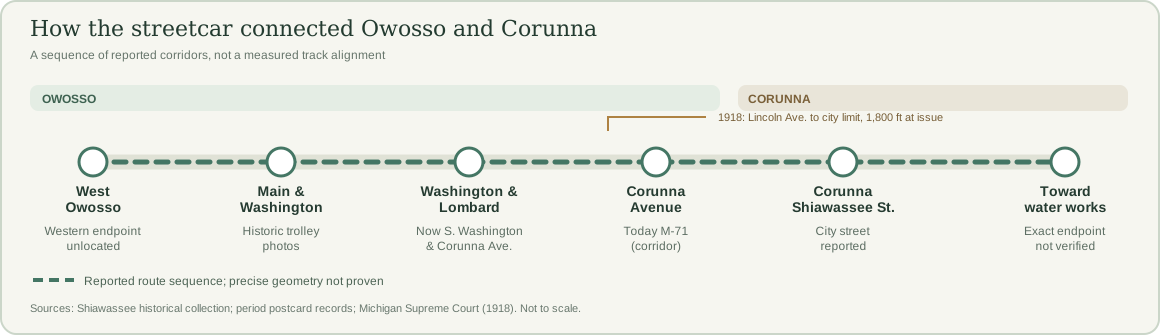
Open full-size route schematic ↗
The corridor sequence comes from a local historical collection; the Main and Washington streetcar scene is supported by period postcards, and the 1918 Corunna Avenue segment is documented in a Supreme Court opinion. Collector account · Streetcar postcards · 1918 court record
1. West Owosso and the approach downtownApproximate
The collector describes service originating in West Owosso and proceeding east to Washington Street. The western terminus, stops, and exact streets of the approach have not been confirmed in a map or timetable.
Modern comparison: West Owosso area on OpenStreetMap.
2. Downtown Main and Washington StreetsPhotographically documented
Period Washington Street trolley postcards and local archive views of tracks on Main Street independently establish street railway infrastructure downtown. They do not establish a complete turn-by-turn route for every period.
Modern comparison: Main and Washington intersection.
3. Washington Street south to Lombard AvenueLocal-history account
A historical collector describes cars running south on Washington to Lombard Avenue. The modern connection is South Washington Street at Corunna Avenue (M-71). The exact crossover and the chronology of the Lombard name need additional primary documentation.
Modern comparison: South Washington and Corunna Avenue.
4. Corunna Avenue toward the city boundary1918 court evidence
The Michigan Supreme Court describes tracks between Lincoln Avenue and the eastern city limits, including an approximately 1,800-foot segment the city ordered shifted from the side of the road to its center. This establishes a specific disputed corridor, not an exact digital track trace.
Modern comparison: Corunna and Lincoln avenues.
5. Downtown Corunna and the water-works endLocal-history account
The local archive reports the line reached Shiawassee Street in downtown Corunna and continued south toward a water facility. Exact curves, stops, and the terminal remain unverified, especially after the 1913 route rebuilding.
Modern comparison: Shiawassee Street, Corunna.
Original map comparisons: Owosso 1900 Sanborn sheets · Corunna 1908 Sanborn sheets. These archival sheets are public domain, but streetcar alignment on individual sheets has not yet been fully traced.
Local streetcars and the wider interurban system
The Owosso–Corunna streetcar was distinct from the longer-distance Michigan United electric interurban service connecting Owosso with places including Perry, Lansing and Jackson, even though operators and some track infrastructure overlapped. The historical collection places a Michigan United interurban station at 113 South Washington Street and identifies an interurban car photographed there on July 3, 1914. Such photographs should not be mislabeled as proof that a particular longer-distance car served every local Corunna stop.[3]
This distinction helps explain the different railway names appearing in directories, newspaper articles and court documents. An operator, a corporate owner, a local route and a regional interurban network are related but not interchangeable.[2][4]
The 1913 Corunna track dispute and rebuilding
Excerpts attributed to the contemporary Owosso Argus-Press, preserved by a local historical collector, describe a period of serious conflict between Corunna officials and railway management in 1913. A July account says crews removed deteriorated tracks in Corunna during a Sunday operation after arguments about track conditions and obligations under an older local franchise.[3]
A reproduced item dated November 14, 1913 reports that a substantially rebuilt Owosso–Corunna electric route was nearly finished, with workers connecting it to the new alignment in Caledonia Township. Another item, attributed to December 1913, describes remaining trolley-pole work, tiling and grading alongside the track.[3]
These are valuable historical leads, but the original newspaper pages have not yet been checked. The article therefore attributes them to reproduced newspaper excerpts rather than presenting every reported detail as independently verified.
The 1918 fight over Corunna Avenue
The most substantial directly identified legal record is City of Owosso v. Michigan United Railways Co., decided by the Michigan Supreme Court on June 3, 1918. Owosso ordered the railway to move approximately 1,800 feet of track from the side to the center of Corunna Avenue between Lincoln Avenue and the city limits, in connection with a planned macadam road improvement. The railway challenged the city's authority and the reasonableness of requiring the work.[4]
The Supreme Court affirmed the order. Its reasoning emphasized the city's reserved powers under the railway's franchise and the relevance of road safety, drainage and public convenience. The opinion noted that the track was already in the center of the street along most of the corridor between downtown Owosso and Corunna, but the disputed segment forced eastbound travelers to cross the rails twice.[4]
That decision captures an enduring question about public infrastructure: when a private company installs facilities in public streets, who controls their placement, and who bears the burden when community needs change? The case documents Owosso's response during a period when electric railways, horse traffic and an expanding road network competed for the same space.
A second 1918 Supreme Court case, Coston v. Ann Arbor Railroad, describes the electric railway running along the south side of Corunna Avenue near its crossing of the Ann Arbor Railroad, with hourly service in each direction. It is a separate legal case, arising from a collision, but supplies useful contemporaneous geographical and operating detail.[16]
Decline and replacement by buses
A compiled Michigan transit chronology lists the local streetcar system as passing into a Michigan Electric Railway Company period in 1923 and ending service in 1929. Other local histories describe a more general decline by the early 1930s as automobiles and bus operators drew travelers away.[2][5]
A newspaper excerpt reproduced in the local historical collection describes a 1928 proposal to replace the Owosso–Lansing interurban with bus service. That proposed longer-distance service change is relevant regional context, but it is not proof of the date of the final Owosso–Corunna local streetcar trip.[3]
The exact final date of Owosso–Corunna streetcar service, the last operator, and the removal dates for different portions of track remain topics for additional archival research.
Photographs, maps and research questions
A contemporary financial summary is available through the 1908 Electric Railway Section ↗, while the January 1899 engineering survey notice ↗ provides a period reference for the Durand extension proposal. The full chapter on this line in Krentel's 2024 Michigan railway history is still not available in the material reviewed here.[6][7][9]
The lead photograph was supplied to this project as `owotraction2.jpg`. It shows an Owosso & Corunna Traction Company car displaying bunting. Original source pending: the photographer, exact date, first publication, and original collection or rights holder have not been established. A copy of the photograph appears in an online local-history collection ↗, but that appearance does not establish ownership or original provenance. We welcome documented information about the original print or negative.
- Owosso & Corunna Street Railway: other early steam and electric cars ↗. External historical collection; original photograph rights and dates vary.
- Washington Street, Owosso: historic streetcar postcard ↗. Street scene from Jon Bell's postcard collection; publication history of this scan not confirmed.
- 1900 Owosso Sanborn maps ↗ and 1908 Corunna Sanborn maps ↗, held by the Library of Congress and publicly reusable. Sheet-level mapping is still needed.
Open questions: What exact day did passenger service start in 1893? When and by whom were the first steam cars replaced? Which municipal franchise and corporate filings establish ownership changes? What became of the proposed Durand extension? Where were the car barns and power facilities? Was the entire reconstructed 1913 route relocated, and where? When was the final local car operated? Contemporary newspapers, city commission minutes, railway timetables and primary corporate records are needed to answer these responsibly.
References
- 1. Past and Present of Shiawassee County: Electric Lines section ↗. Michigan Historical Publishing Association. Accessed October 24, 2026.
- 2. Transit Systems in Michigan: Owosso ↗. ChicagoRailfan. Accessed October 24, 2026.
- 3. Michigan United Traction Co.: Owosso interurbans and period newspaper excerpts ↗. ShiawasseeHistory.com, Steve Schmidt. Accessed October 24, 2026.
- 4. City of Owosso v. Michigan United Railways Co., 202 Mich. 37 (1918) ↗. Michigan Supreme Court. Accessed October 24, 2026.
- 5. Owosso & Corunna Street Railway Co. ↗. ShiawasseeHistory.com, Steve Schmidt. Accessed October 24, 2026.
- 6. Electric Railway Section: Owosso & Corunna Electric Co. (September 26, 1908) ↗. The Commercial & Financial Chronicle / Federal Reserve Bank of St. Louis FRASER. Accessed October 24, 2026.
- 7. Electric railway extension survey at Corunna (January 5, 1899) ↗. Engineering News / American Railway Journal. Accessed October 24, 2026.
- 8. Owosso & Corunna Electric Company (E) ↗. MichiganRailroads.com. Accessed October 24, 2026.
- 9. Michigan Railway Company: The Northern and Southern Divisions ↗. Michigan State University Press. Accessed October 24, 2026.
- 10. Michigan Official Directory and Legislative Manual, 1911–1912: Electric Railways of Michigan ↗. State of Michigan. Accessed October 24, 2026.
- 11. McGraw Electric Railway Directory: Owosso & Corunna Electric Co., 1898 ↗. McGraw Publishing Company (transcribed historical directory data on Wikimedia Commons). Accessed October 24, 2026.
- 12. Streetcar Postcards: Washington Street, Owosso ↗. Jon Bell transit postcard collection. Accessed October 24, 2026.
- 13. Sanborn Fire Insurance Map from Owosso, January 1900 ↗. Library of Congress Geography and Map Division. Accessed October 24, 2026.
- 14. Sanborn Fire Insurance Map from Corunna, June 1908 ↗. Library of Congress Geography and Map Division. Accessed October 24, 2026.
- 15. South Washington Street Corridor Study, Owosso (2013) ↗. Michigan State University Urban & Regional Planning / City of Owosso. Accessed October 24, 2026.
- 16. Coston v. Ann Arbor Railroad, 201 Mich. 232 (1918) ↗. Michigan Supreme Court. Accessed October 24, 2026.